In high-performance sports, acceleration and top speed frequently take center stage. However, deceleration is equally important and is often neglected in testing protocols. The Deceleration eBook by Dr. Damian Harper, in collaboration with Photon Sports (2025), underscores that deceleration is one of the most under-examined components of performance testing. Overlooking this aspect can lead to inefficiencies, diminished performance, and an increased risk of injury among athletes.
What Is It and Why Does It Matter?
Deceleration is the body’s ability to absorb and control braking forces during rapid stops or directional changes, relying on eccentric strength to manage load. As PhD researcher Martin Nugent notes, deceleration is not only vital for safety, particularly in injury prevention, but also for effective change of direction and overall performance efficiency.
- Distributes braking forces across steps (Harper & Photon Sports, 2025)
- Reduces injury risk through trunk and knee control (Harper & Photon Sports, 2025)
- Creates benchmarks for smarter return-to-play decisions (Taberner & Allen, 2021)
This highlights the urgent need to prioritize deceleration training before speed development. It is a highly demanding task, subjecting up to 5.9 times an athlete’s body mass through a single limb (Harper 2024), far more than the 1.2 to 2 times body mass experienced during acceleration. As Harper & Kiely (2018) note, it plays a critical role in both performance and injury prevention.
From Research to Practice
Poor braking mechanics amplify joint loading and contribute to non-contact ACL injury risk (Dos’Santos et al., 2018), making effective testing and training essential.
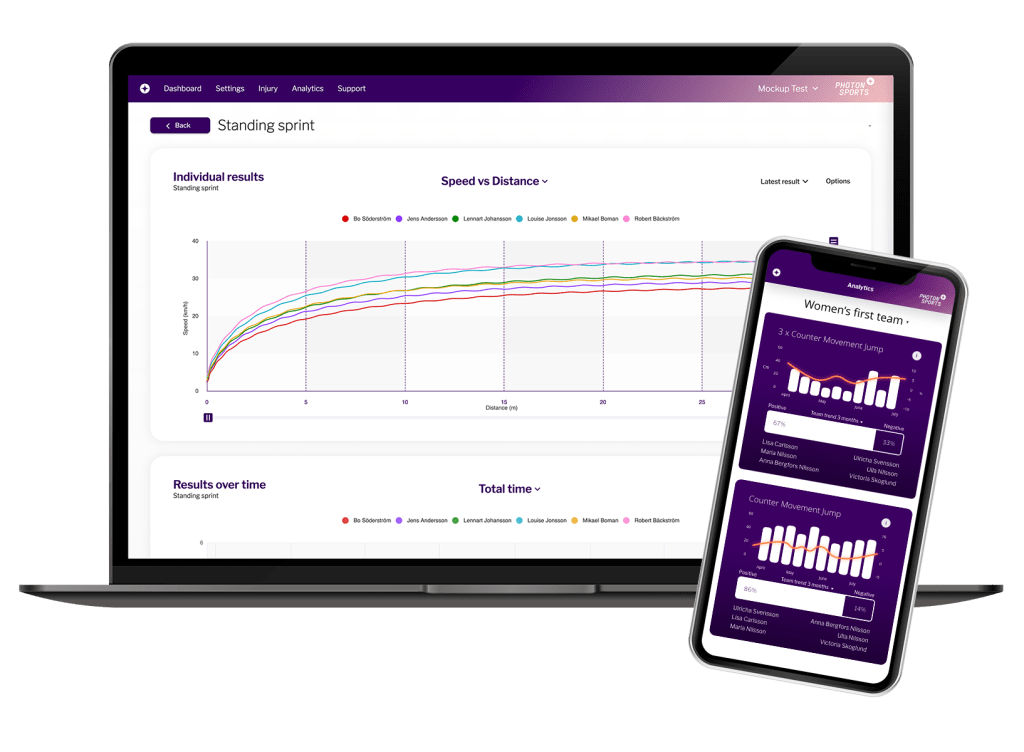
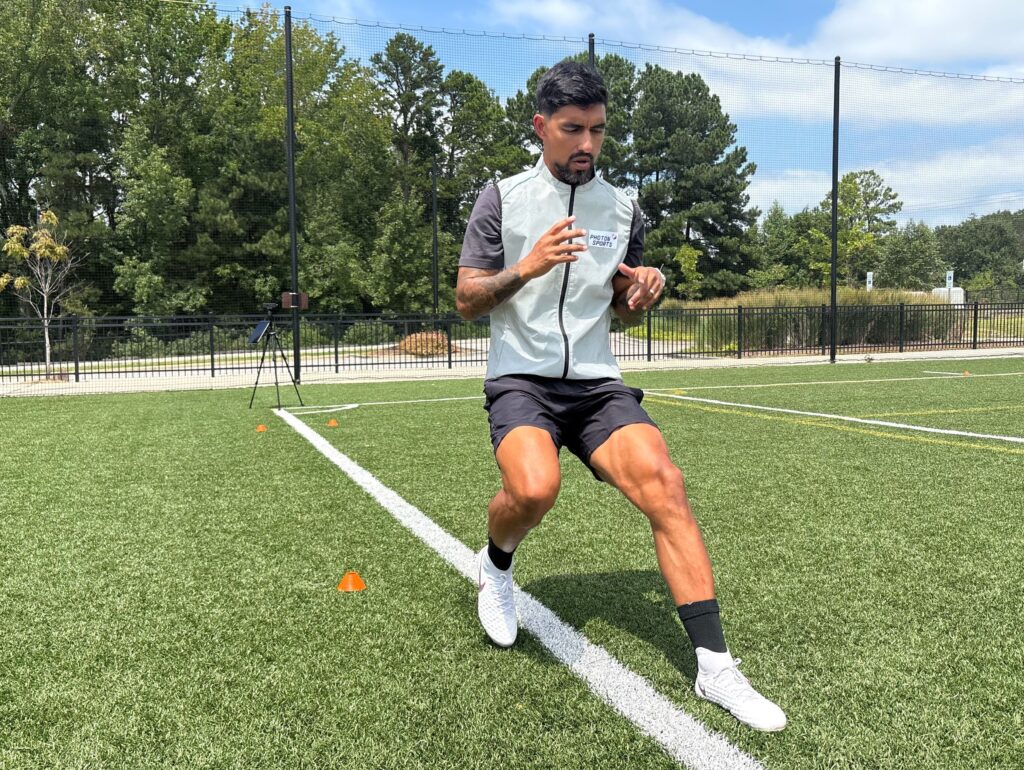
Photon integrates deceleration tests such as ADA, 5-0-5, and CUT tests directly into applied workflows, capturing synchronized movement without the complexity of lab setups. With built-in visual guidance, Photon makes it easy to assess, monitor, and track athlete movement patterns.
For performance staff, this means the ability to:
- Identify inefficient or high-risk movement patterns
- Benchmark athlete progress across training and rehab
- Deliver insights for injury prevention and return-to-play strategies
At Photon, we have recently released a free Deceleration eBook, written by Dr. Damian Harper in collaboration with Photon Sports. It’s the third release in our eBook series, following the S-MAS and C-MAS launches.
📥 See it in action 👉 Download Free eBook
References:
Harper, D. J., & Kiely, J. (2018). Damaging nature of deceleration in team sports: Always keep the brake on? Strength & Conditioning Journal, 40(5), 8–17.
Dos’Santos, T., Thomas, C., Comfort, P., & Jones, P. A. (2018). The effect of angle and velocity on change of direction biomechanics: Implications for agility performance and injury risk. Journal of Sports Sciences, 36(22), 2429–2436.
Harper, D. & Photon Sports. (2025). Deceleration eBook. Photon Sports.
Taberner, M., & Allen, T. (2021). Monitoring and managing return to play: The role of deceleration. International Journal of Sports Physiology and Performance, 16(9), 1242–1248.
Nimphius, S. (2014). Strength and conditioning considerations for female athletes. Strength and Conditioning Journal, 36(3), 36–44.