Clubs in OBOS Damallsvenskan will now test their players’ physical capacity on a shared, standardised schedule. The initiative comes from Elitfotboll Dam (EFD) and Swedish sports technology company Photon Sports. Its aims are healthier players, better input for training and new research on women’s football’s own terms.
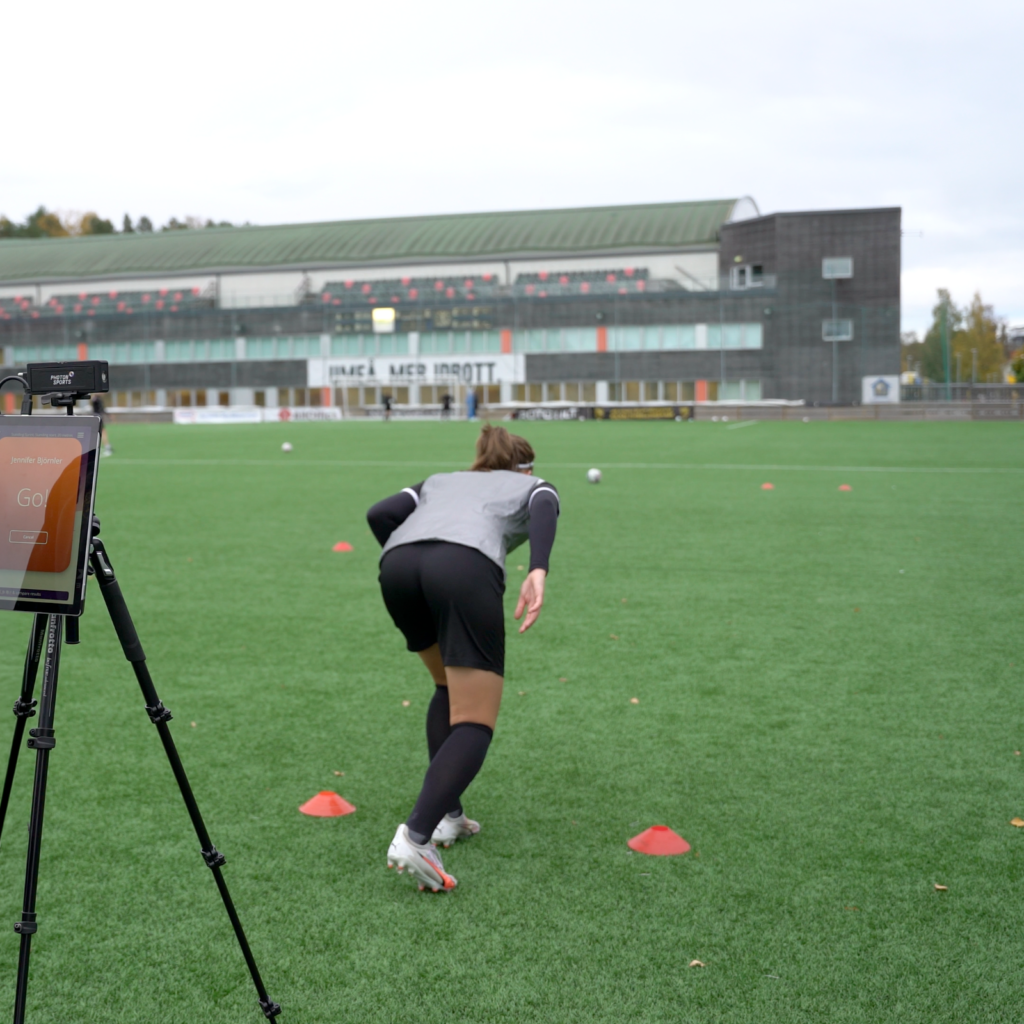
Four times a year, the clubs will run the same tests of speed, change of direction and explosive power, all of them key abilities in match play. The tests cover both the senior players in OBOS Damallsvenskan and the U19 players in the clubs’ elite development programmes. Photon Sports supplies the equipment through EFD.
Individual baselines for every player
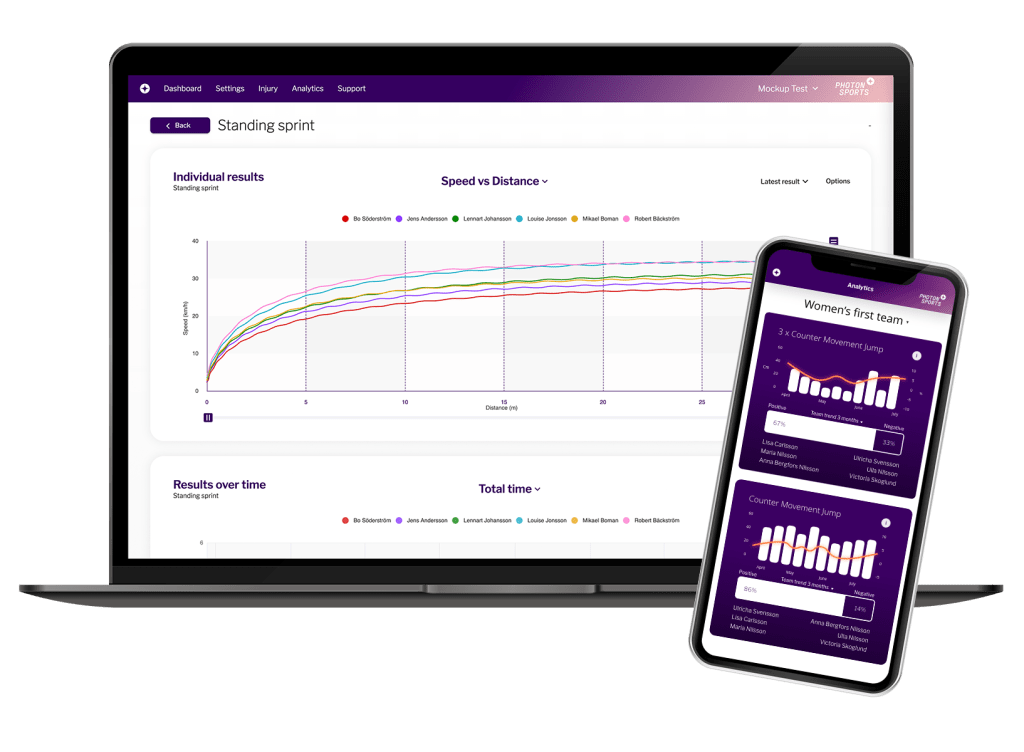
With repeated testing, each player gets an individual baseline. This lets staff follow the players development over time and adapt the players training. Spotting changes and individual needs early helps both performance development and injury prevention. This matters especially in women’s football, where there is a great need for more knowledge and individualised training.
The baselines also make the return from injury safer. When rehabilitation is guided by the player’s own values, the risk of re-injury and lasting loss of performance goes down.
Benchmarks for the whole league
When every club tests the same way, a coherent dataset builds up over several seasons. Results can be compared over time and between teams, and the league gets benchmarks for the physical demands of OBOS Damallsvenskan. Academies and elite development programmes get clearer targets, which can help young players be better prepared for the step up to senior elite level.
“We now have clear benchmarks for the physical demands of playing in OBOS Damallsvenskan. That helps both today’s elite players and the next generation, and it strengthens Swedish women’s football internationally,” says Kirsten van de Ven, Sporting Director at Elitfotboll Dam.
Research focused on ACL injuries
The dataset will also be used for research. The first focus is on deceleration ability as a possible risk factor for anterior cruciate ligament (ACL) injuries. The goal is to analyse how physical capacity, injuries and match demands relate to each other, and to develop evidence-based recommendations for women’s football specifically.
“Research on physical performance and injuries has long been based on men’s football. Here we are building knowledge from the conditions of women’s football itself, with league-wide data,” says Anders Tånger, CEO of Photon Sports.
The long-term goal is healthier senior and elite development players who are available for selection more often. That in turn should make Swedish women’s football more competitive internationally, with faster, more agile and physically better-prepared players.
Built on a pilot study of more than 8,000 tests
The initiative builds on a partnership that began in 2022. During the 2022 and 2023 seasons, clubs in OBOS Damallsvenskan took part in a pilot study and followed a shared schedule of sprint and jump tests. More than 8,000 tests were collected from over 400 players. What set the study apart was that it covered an entire league rather than individual teams.
The data was analysed by Dan Fransson (PhD, University of Gothenburg), Helena Andersson (PhD, Umeå University) and Hannah Hutterman (MSc). One of the findings was that jump height is a strong marker of a player’s top speed. This means a simple jump test (CMJ) can be used to indicate whether a player is ready to perform at high speed.
Fact box: the three tests
- 30-metre linear sprint: The player runs 30 metres in a straight line against the clock. Measures acceleration and top speed.
- 505 sprint: The player runs at full speed, turns 180 degrees and sprints back five metres. Measures the ability to decelerate and change direction.
- Countermovement jump (CMJ): A vertical jump from standing, where the player drops quickly into a squat and jumps straight up. Measures explosive leg power.
The tests are carried out every quarter using equipment from Photon Sports.
About Photon Sports
Photon Sports is a Swedish sports technology company that develops testing equipment and analysis tools for physical performance and injury prevention. The company works in a research- and data-driven way and brings together engineers, software developers, sports medicine staff, researchers and designers.